- Home
- We Are Law School
- News
- Rethinking Leadership In Law Firms In The Era Of Ai And Change
Rethinking leadership in law firms in the era of AI and change

Prof. Dr. Madeleine Bernhardt presents Leading Transformation in Law Firms and joins leaders from Cuatrecasas, RocaJunyent, and Gómez-Acebo & Pombo to discuss the human side of change in the legal sector.
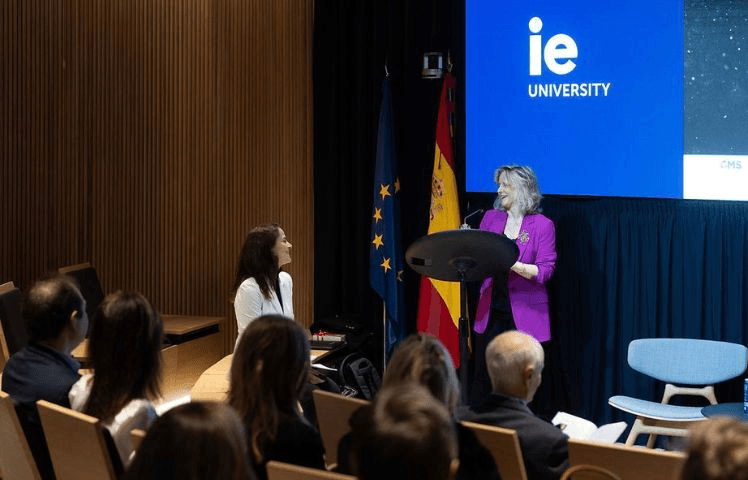
As part of its mission to foster research-driven dialogue and advance knowledge on the evolution of the legal profession, the LawAhead Center on the Legal Profession at IE Law School hosted an event on March 11 to present Leading Transformation in Law Firms: How Top Leaders Unlock Performance to Win the Future, the latest book by Prof. Dr. Madeleine Bernhardt.
Prof. Dr. Bernhardt, a research collaborator of the LawAhead Center and Director of the Center on the Legal Profession at Bucerius Law School, introduced the core insights of her new publication before participating in a panel discussion with three leading managing partners — Joan Roca (Managing Partner, RocaJunyent), Javier Fontcuberta (Managing Partner, Cuatrecasas), and Carlos Rueda (Senior Partner, Gómez-Acebo & Pombo) — who contributed to the research through the survey conducted for the book.
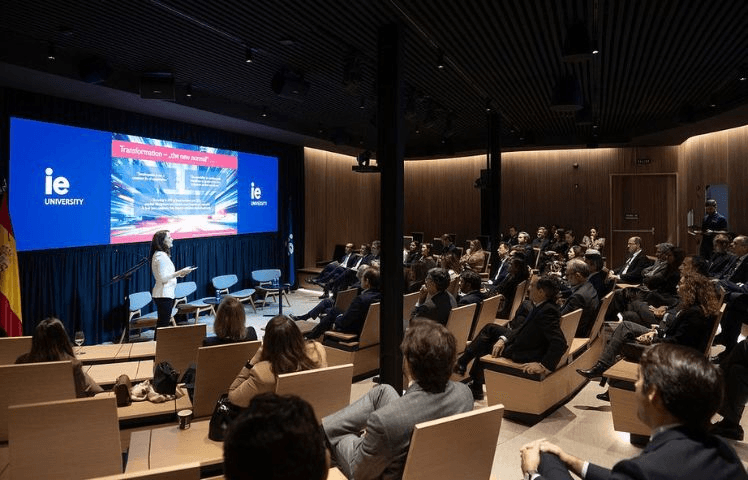
The event, held at the Aula Magna of IE University in Madrid, brought together senior representatives of the legal sector and was opened by Soledad Atienza, Dean of IE Law School, and Luis De Carlos, Chairman of the LawAhead Center.
ADAPTIVE CULTURES AND SUCCESS IN TRANSFORMATION
Law firms today face a perfect storm of disruption: rapid technological advances, rising competition from new entrants, shifting client demands, and an intensifying battle for top talent. In this environment, strategy and technology are not enough. What determines whether transformation succeeds or fails is leaders enabling people and teams to drive and thrive amid transformation.
Leading Transformation in Law Firms examines the human dimension of organizational change within law firms from a research-based perspective. Drawing on more than two decades of advising law-firm leaders, 35 in-depth interviews with senior executives, and extensive organizational research, the book introduces the ACT-to-Transform® framework — an evidence-informed model outlining nine areas leaders must address to foster adaptive cultures and strengthen long-term resilience.
During her remarks, Bernhardt highlighted a striking figure: 70% of transformation initiatives fail. She noted that "Considering that organizations will spend billions on transformation initiatives over the next year, a 70% failure rate equates to a significant erosion of value," and stressed that despite heavy investment in emerging technologies, leadership attention often remains focused on tools rather than on people and culture.
FROM RESEARCH TO LEADERSHIP PRACTICE
Following Bernhardt’s intervention, the conversation turned to how these insights translate into day-to-day leadership. In this context, participants emphasized that meaningful AI transformation does not begin with algorithms, but with a sophisticated understanding of trust and a deliberate effort to cultivate it across teams and client relationships.
Joan Roca, Managing Partner of RocaJunyent, framed his contribution around what he described as the "three Ts": Team, Trust, and Transformation. "Transformation is often treated as something given, but it does not happen by itself," he stated. He emphasized that client trust remains the cornerstone of legal practice and that authenticity is essential when leading change. Referring to generational dynamics, he added: “We need as many opinions as possible. Getting facts wrong is a mistake; sharing an opinion is not.” Creating an environment where people feel safe expressing their views strengthens both the team and overall performance.
Javier Fontcuberta, Managing Partner of Cuatrecasas, highlighted the magnitude of the shift facing the profession: "Change is something profound and transformative. We must understand how change will reshape our profession. If you don’t face the challenges we have ahead, you run the risk of not being here in a few years." He pointed to the mindset shift required within firms: "We are trained to attack the contrary position, and we need now to be open-minded."
Carlos Rueda, Chairman of Gómez-Acebo & Pombo, addressed the complexity of managing risk while fostering adaptability: "In our firms, we operate under the premise that we cannot make mistakes with our clients. That conditions everything we do." He added that if firms assume past success guarantees future stability, it may be too late to react.
He stressed the importance of thinking about the future of the firm and educating younger generations in responsibility to clients and the organization. "Culture cannot be used as a stopper. Culture is about actions. Trusting your people means accepting that they will make mistakes and take responsibility for them."

STRENGTHENING ACADEMIC AND GLOBAL COLLABORATION
Prof. Dr. Madeleine Bernhardt will soon teach the course "Human + AI: Building and Leading High-Performing Human-AI Teams" at IE Law School for LL.M. students.
This collaboration is further strengthened through the Global Network of Centers on the Legal Profession, established in April 2025, reinforcing IE Law School’s commitment to advancing research, dialogue, and global collaboration on the future of the legal profession.
ABOUT THE LAWAHEAD CENTER ON THE LEGAL PROFESSION
The LawAhead Center on the Legal Profession at IE Law School promotes reflection on the challenges and opportunities facing the legal sector in Spain and globally. The Center brings together leading business law firms—CMS Albiñana, Cuatrecasas, Gómez-Acebo & Pombo, Garrigues, Pérez-Llorca, Roca Junyent, and Uría Menéndez— alongside major corporations such as AENA, CaixaBank, Mapfre, Microsoft, and Telefónica.


