- Home
- We Are Law School
- News
- Ie Law School And Thomson Reuters Institute Presented New Report On Europe’s Legal Markets
IE Law School and Thomson Reuters Institute presented new report on Europe’s legal markets

Developed with IE Law School as its research partner, this was the first Thomson Reuters Institute report devoted specifically to continental Europe. It highlighted cautious growth, strong prospects in Spain and France, and the changing influence of client expectations and artificial intelligence on the legal sector.
IE Law School and Thomson Reuters Institute presented the 2026-2027 State of European Legal Markets report on 5 November 2026 at IE Tower in Madrid. The report brought together the perspectives of 215 corporate legal buyers across 22 countries and 347 client-nominated stand-out lawyers across 27 European markets. The presentation formed part of the activities of IE Law School’s LawAhead Center on the Legal Profession.
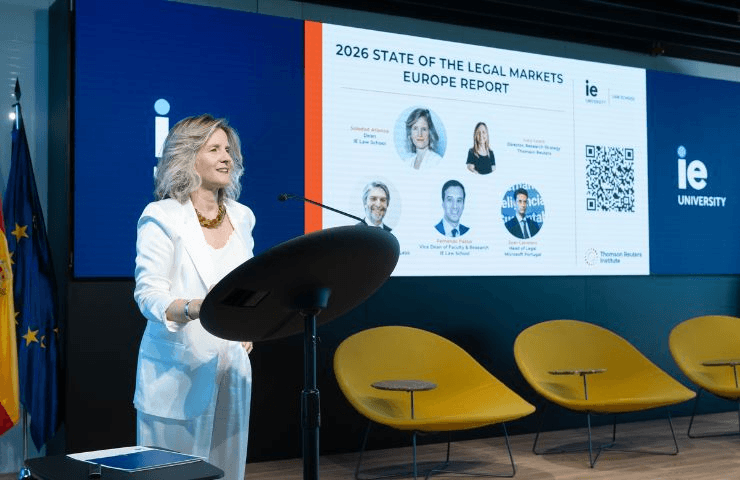
The collaboration places IE Law School alongside other leading academic institutions involved in major studies in the series, including Georgetown Law and Oxford University’s Saïd Business School, and reinforces the School’s leadership in research on the future of the legal profession.
Soledad Atienza, Dean of IE Law School, opened the event by underlining the role of academic institutions in supporting research that can inform professional practice. At IE Law School, she explained, this involves preparing students at the intersection of the business of law, independent judgment and AI.
Lucy Leach, Director of Research Strategy at Thomson Reuters Institute, presented a detailed overview of the report’s market dynamics and findings. Her presentation explored how regulatory pressures, technological change and evolving business priorities are reshaping legal services, while underscoring the enduring importance of expertise, judgment and human skills.

The presentation was followed by a panel discussion moderated by Fernando Pastor, Vice Dean of Faculty and Research at IE Law School. The panel brought together Alfonso Codes, Managing Partner at CMS Albiñana, and Juan Carretero, Head of Legal at Microsoft Portugal.
A positive but uneven outlook
The report identified grounds for cautious optimism. Across Europe, 67% of legal buyers expected their external legal spending to remain stable or increase over the following 12 months, although prospects varied considerably between countries and practice areas.
Spain and France showed the strongest growth prospects among the markets examined. Spain stood out in particular, with only 14% of legal buyers expecting to reduce their spending. Italy presented a more restrained outlook, while expectations across Northern Europe and the Benelux markets were mixed. Regulatory work offered particularly significant opportunities for growth, reflecting developments such as the EU AI Act, ESG reporting requirements and an increasingly demanding regulatory environment. Mergers and acquisitions, disputes and corporate work were also expected to attract additional investment.
Fernando Pastor framed the panel discussion around this positive but uneven outlook. Alfonso Codes pointed to growth in technology-related work, regulated industries, energy and cybersecurity. He argued that the modern lawyer must act as a genuine business partner, combining deep legal expertise with an effective use of technology.

Client expectations were redefining value
The report suggested that growth in legal spending would not benefit every firm equally. Legal expertise and successful outcomes remained essential, but clients increasingly expected advice that demonstrated a clear understanding of their businesses and connected legal judgment with commercial impact.
Firms were able to justify premium fees through expert advice, strong results, transparency and client-focused support. By contrast, dissatisfaction was more often linked to poor communication, limited business understanding or problems with delivery than to price. The findings therefore reinforced the importance of both client focus and a clear strategic position.
Moving from AI strategy to measurable value
Artificial intelligence emerged as one of the most important forces reshaping the market. More than half of European general counsel identified AI implementation as a leading opportunity for law firms to differentiate over the following five years.
European firms had responded quickly: 91% of the lawyers surveyed believed their firm had a clear AI strategy. However, only 55% reported having a strategy for monetizing it. Efficiency and time savings remained the clearest benefits, while AI’s wider effects on legal work and client satisfaction were still less evident.
The report also identified a gap between firms’ internal planning and their engagement with clients. Only 20% of stand-out lawyers had held substantive AI discussions with most or all their clients, suggesting that many firms had yet to explain clearly how technology would affect services, outcomes and value.
Juan Carretero observed that in-house teams were not necessarily facing more complex individual legal issues. The challenge was one of scale: as business activity multiplied, so did legal and regulatory needs. He described Microsoft’s approach as bringing together knowledge, people and technology to respond to that growing demand.

The next horizon
The report pointed to a broader challenge for the profession: translating technological adoption into demonstrable value for clients. This required not only technical capability, but also strategic vision, commercial awareness, sound judgment and more meaningful conversations about how AI was changing legal work.
Returning to the implications for legal education, Fernando Pastor argued that legal training should remain rigorous and broad-based while continually creating space for technology. He identified AI literacy as one of the principles guiding how IE Law School prepares future legal professionals.
Overall, the report reinforced a central message: technology alone would not determine the future of the legal profession. Success would depend on combining innovation with strategic clarity, a deep understanding of clients and the human judgment required to transform technological capability into meaningful value.
The full 2026-2027 State of European Legal Markets report can be downloaded here.


