- Home
- News And Events
- News
- Ie University And The European Commission Highlight Research Excellence At Marie Skłodowska-curie Actions 30th Anniversary
IE University and the European Commission Highlight Research Excellence at Marie Skłodowska-Curie Actions 30th Anniversary

Since its launch in 1996, MSCA has supported more than 150,000 researchers worldwide, with 25 Nobel Prize laureates among the scientists and professionals involved in its initiatives.
Madrid, 26 November 2026 - IE University marked the 30th anniversary of the Marie Skłodowska-Curie Actions (MSCA), the European Union's flagship program for doctoral education and postdoctoral research, with an event held at IE Tower, its campus in Madrid. The celebration featured a keynote by Daniel Calleja y Crespo, Head of the European Commission Representation in Spain, and brought together Manuel Muñiz, Rector of IE University; Juan Santaló, Vice-Rector of Faculty & Research; Fabrizio Salvador, Dean of IE Doctoral School; Marco Giarratana, Vice Rector of Scientific Knowledge and Impact; and IE University's Marie Skłodowska-Curie Actions fellows.
Manuel Muñiz highlighted IE University's commitment to strengthening its research capabilities, including, among other initiatives, the recent recruitment of 30 new faculty members and researchers as part of its Faculty & Research strategy. Muñiz also emphasized the importance of attracting international talent, fostering interdisciplinary collaboration, and connecting academic research with societal challenges.
"Europe's ability to shape its future depends, to a large extent, on its commitment to knowledge. This is where the Marie Skłodowska-Curie Actions play a vital role, embodying a fundamental conviction of the European project: sharing talent, opening our institutions, and collaborating in research to better address the major challenges of our time," said Manuel Muñiz, Rector of IE University.
Launched in 1996, the Marie Skłodowska-Curie Actions has supported more than 150,000 researchers worldwide, with 25 Nobel Prize laureates among those involved in the program. Since 2005, 11 Marie Skłodowska-Curie fellows have conducted research at IE University, contributing to the institution's scientific output and fostering international collaboration.
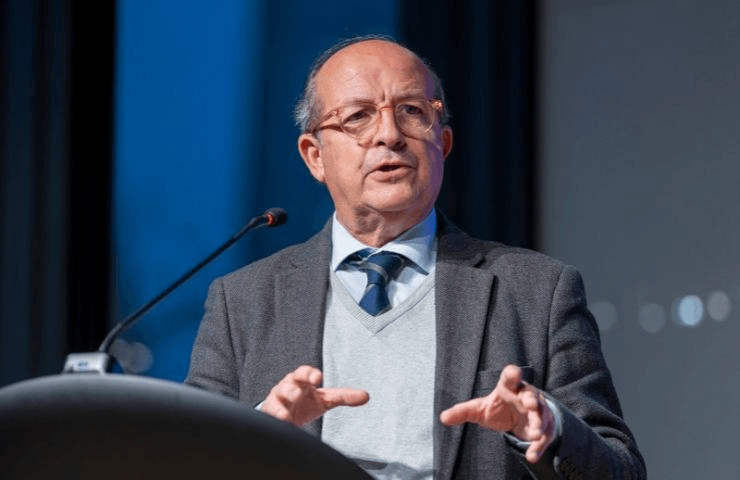
Calleja y Crespo highlighted the program's contribution to European scientific excellence and competitiveness and noted that approximately 40% of MSCA researchers come from outside the European Union, underscoring Europe's ability to attract international talent.
Calleja y Crespo also emphasized the program's role in improving research careers, working conditions, and cooperation between academia and industry: "Marie Skłodowska-Curie Actions’s real value is its role as pathfinder and as standard setter, demonstrating that excellent doctoral and postdoctoral training can encourage institutions and national programs to raise their own standards".
Looking ahead, Calleja y Crespo stressed the importance of sustained investment in scientific talent: "If Europe wants to lead in science and innovation, continued investment will be the key. Talent is a fundamental driver of competitiveness". "We need to bring this knowledge closer to the real economy, so that we can compete globally", added the Head of the European Commission Representation in Spain.
Juan Santaló reflected on IE University's transformation into an international, multidisciplinary research institution, noting that its output in leading academic journals has increased fivefold since 2019. Santaló also outlined the university's strategy to strengthen research across four priority areas: productivity and sustainable growth; democracy and the rule of law; health, longevity and well-being; and climate change. “We strive to foster positive change through the research we produce,” said the Vice-Rector of Faculty & Research at IE University, emphasizing the importance of multidisciplinary collaboration in addressing major societal challenges.
From European funding to research impact
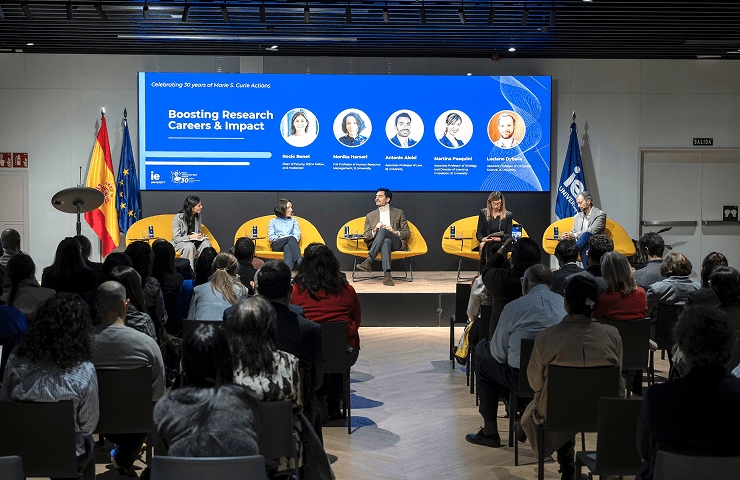
A panel moderated by Rocío Bonet, Dean of Faculty at IE University and a former Marie Skłodowska-Curie Actions fellow, brought together researchers from IE University who have benefited from the program at different stages of their careers. Their experiences illustrated how European funding can support ambitious projects, open new areas of inquiry, and extend the impact of academic research beyond universities.
Monika Hamori, Full Professor of Human Resource Management and IE University's first MSCA fellow in 2005, explained how the fellowship provided the resources to undertake an ambitious study of the career paths of European executives."This fellowship allowed me to compile a large dataset," Hamori recalled, describing how the funding enabled her to hire research assistants to gather information from sources around the world. The project resulted in four academic papers and attracted international media coverage.
Martina Pasquini, Associate Professor of Strategy and Director of Learning Innovation, described how her fellowship helped her pursue a new research direction focused on B Corporations and purpose-driven businesses. "I decided to give a twist to my research agenda," Pasquini explained, reflecting on how the funding allowed her to explore an emerging field and establish international academic networks.
Antonio Aloisi, Associate Professor of Law discussed how his MSCA-funded project Boss Ex Machina, focused on algorithmic management and labor rights, contributed to research informing European policymaking, including work related to the EU Directive on improving working conditions in platform work."The fellowship was life-changing. It gave me the opportunity to conduct focused research, to gain this protected time, which for researchers is the most precious currency," Aloisi explained.
Luciano Dyballa, Assistant Professor of Computer Science and a current MSCA fellow, described his work combining neuroscience and AI to better understand neural networks. Dyballa highlighted how the fellowship has enabled him to establish international collaborations and develop new research activities at IE University. "The financial support, but also the recognition that comes with it," Dyballa explained, has helped him connect with researchers across disciplines and institutions.