- Home
- News And Events
- News
- New Book From Ie University’s Unesco Chair Rethinks The Relationship Between Ai And Democracy
New Book from IE University’s UNESCO Chair rethinks the relationship between AI and democracy

‘Recoding Democracy’, by Professor Theodore Lechterman, seeks to redefine what democracy demands of AI and reimagine democracy itself, reshaping the debate on AI’s political future.
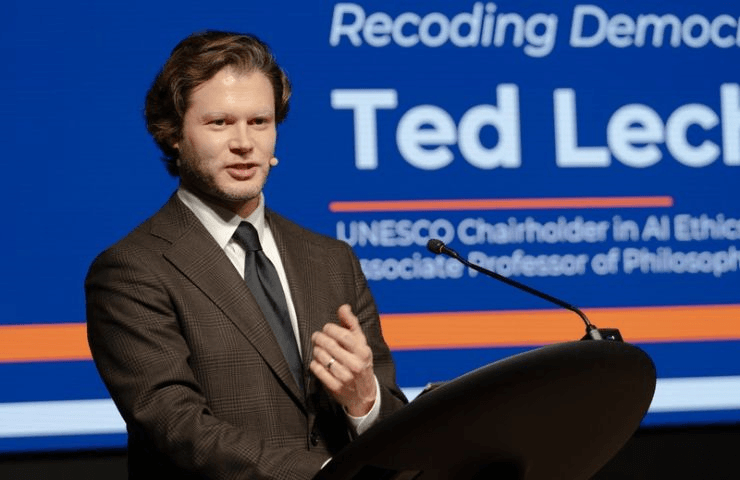
IE University hosted the pre-release celebration of ‘Recoding Democracy: AI and the Fight for Our Democratic Future’, the new book by Theodore "Ted" Lechterman, Associate Professor of Philosophy and holder of the UNESCO Chair in AI Ethics & Governance at IE School of Arts & Humanities.
Published by Polity Press, the book challenges pervasive misconceptions about what democratic principles require of AI governance and how AI might help realize democratic ideals. It also examines how AI challenges democracy’s philosophical foundations and limits, including the unsettling possibility of citizenship rights for AI.
"For nearly 3,000 years, political theorists have debated how power should be shared among humans. AI shines new light on this old question and raises new ones that demand fresh thinking by scholars and citizens alike", said Lechterman.
Hosted by the IE School of Arts & Humanities in collaboration with IE Editorial Knowledge, the event featured the author previewing the book’s central claims and debating them with two of the world’s leading philosophers of AI: Iason Gabriel, Principal Scientist at Google DeepMind and Director for AGI and Society at the DeepMind Institute; and Annette Zimmermann, Interim Chair of Political Philosophy at the University of Bayreuth, Assistant Professor of Philosophy at the University of Wisconsin-Madison, and author of ‘Democratizing AI’ (Manchester University Press, 2026).
According to Iason Gabriel, humanity is entering a new phase, where there’s potential to do both harm and good. "Technologies like AI may alter the world in a profound way: it’s up to us to ensure that human wisdom shapes the purpose that it serves, and that we maintain control over our collective future," said Gabriel, who emphasized a huge role for democracy. He told the audience about the civic tech experiments he is involved in and his belief that technology may enrich democracy if the approach is incremental and fully subject to citizens’ control.
During the discussion, Annette Zimmermann said she had the intuition that the "people leading frontier AI teams, and the industry decision makers, do not represent the majority of society. So, how do we get those working in frontier AI to understand the main principles of democratic theory?" She emphasized the importance of citizens being actively engaged in setting their own decision agendas for AI, rather than uncritically accepting decision agendas shaped predominantly by industry decisions. She warned of AI exceptionalism, the tendency to treat AI policy as a decision domain that is uniquely inaccessible to citizens and their elected representatives.
The book will be published outside the United States on November 27, 2026, followed by its United States release on February 2, 2027.