- Home
- News And Events
- News
- World Bank Group And Ie University Convene Global Leaders To Discuss Ai’s Impact On Higher Education And The Future Of Work
World Bank Group and IE University Convene Global Leaders to Discuss AI’s Impact on Higher Education and the Future of Work

IE University contributed, as knowledge partner of the initiative, to an international conference at the intersection of education, skills, and the transformation of work that highlighted the importance of creativity, collaboration, adaptability, and digital fluency as essential skills for the AI era.
Over 400 global experts and leaders from higher education, industry, technology, and public policy were convened by the World Bank Group and IE University to explore how artificial intelligence is reshaping talent development, higher education, and the future of work at the 10th Global Education Conference, "Building Skills for Tomorrow’s Jobs," held on June 17–19 at IE University’s campuses in Madrid and Segovia. The meeting was organized by the International Finance Corporation (IFC), a member of the World Bank Group focused on private sector development and economic growth in emerging markets, in collaboration with IE University.
This is the first time the premier global education conference has been co-hosted with a knowledge partner. Participants examined how institutions can move beyond traditional classroom models by embedding more work-integrated learning, co-curricular experiences, and real-world job exposure into the student journey, to strengthen employability.
"Closing the gap between the skills people have and the skills employers need is not just an education challenge—it is a jobs challenge. The private sector has a critical role to play in shaping both the skills of today and the jobs of tomorrow. This is at the heart of the World Bank Group’s education and skills strategy, and we are proud to partner with IE University to convene partners around solutions that expand opportunity and create a brighter future for young people," said Mamta Murthi, Vice President, People Vertical, World Bank Group.
A central theme of the discussions was the impact of AI and automation on jobs, skill requirements, and access points to employment. The program also explored how generative AI is transforming teaching, learning, and institutional effectiveness, while raising broader questions about what kinds of skills will matter most in the years ahead.
"AI is not replacing human talent, it is redefining its value. As machines take over routine tasks, uniquely human capabilities such as judgment, creativity and an entrepreneurial mindset become the real competitive advantage. Our responsibility, as educational institutions, is to prepare people not for the jobs that exist today, but for the opportunities we are not yet able to imagine," said Juan José Güemes Barrios, Vice President of Strategy and President of the Center for Entrepreneurship & Innovation at IE University.
Another key conversation was the role of higher education in building more agile and inclusive skills ecosystems. The agenda emphasized lifelong learning as a necessary response to economic and technological change, particularly for working adults and vulnerable learners who need continuous opportunities to upskill for professional success and remain employable.
Speakers also addressed the importance of stronger university and industry partnerships, and closer alignment between educational programs and labor market needs, as well as the value of understanding new career pathways through emerging models such as job clustering. The event underscored the urgency of equipping learners not only with technical knowledge, but also with the adaptability, ethical awareness, and human-centered perspective needed to navigate an increasingly complex global context. The broader conference program extended to an AI Day held at IE University’s Segovia campus, further expanding the conversation on technology-powered transformation in education.
Economic, Technological and Geopolitical Transformation
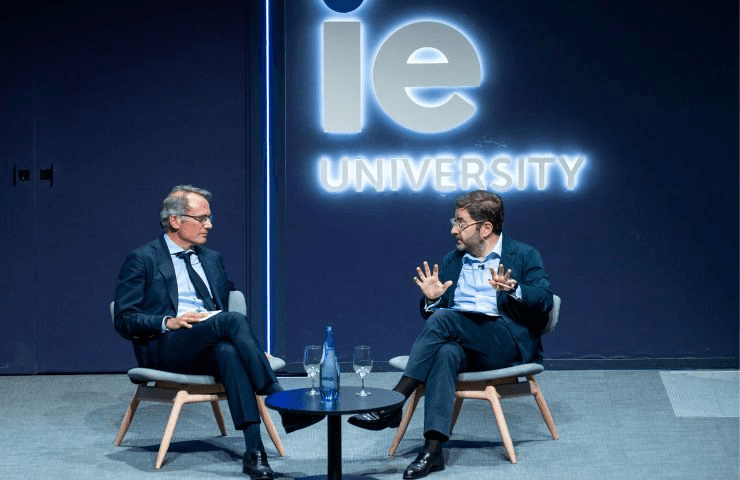
In a fireside chat, Manuel Muñiz, Rector of IE University, and Alfonso García Mora, IFC Regional Vice President for Latin America and the Caribbean, reflected on the state of global politics, economics, and technology, and on how these forces are reshaping education, skills, employability, jobs and entrepreneurship. They highlighted the profound implications of AI and digitalization in education, particularly at a time when 1.2 billion young people in developing countries are expected to enter the workforce over the next 10 to 15 years. Both speakers also underscored the importance of deepening collaboration between academia, industry, and the private sector, while anticipating change, thinking long term, and adapting institutions accordingly.
"Periods of profound economic, technological, and geopolitical transformation place extraordinary demands on societies and institutions. The responsibility of universities is not simply to respond to change, but to help people understand it, navigate it, and ultimately shape it," said Manuel Muñiz, Rector of IE University.
"Latin America and the Caribbean can turn today’s skills gap into tomorrow’s jobs engine. By aligning education with industry demand, and putting industry at the center of skilling, we can equip more people—especially young people and women—for quality jobs, higher productivity, and greater opportunity," said Alfonso García Mora, IFC Regional Vice President for Latin America and the Caribbean.