- Home
- News And Events
- News
- The European Space Agency (esa) And Ie University Sign A Strategic Agreement To Advance Education, Innovation And Talent Development In The Global Space Sector
The European Space Agency (ESA) and IE University sign a strategic agreement to advance education, innovation and talent development in the global space sector

The initiative is conceived as a growing platform, with new partners expected to enhance its reach, diversity and global impact.
The European Space Agency (ESA) and IE University have signed a Memorandum of Understanding (MoU) establishing a strategic framework for collaboration in education, innovation and knowledge creation within the rapidly evolving space sector.
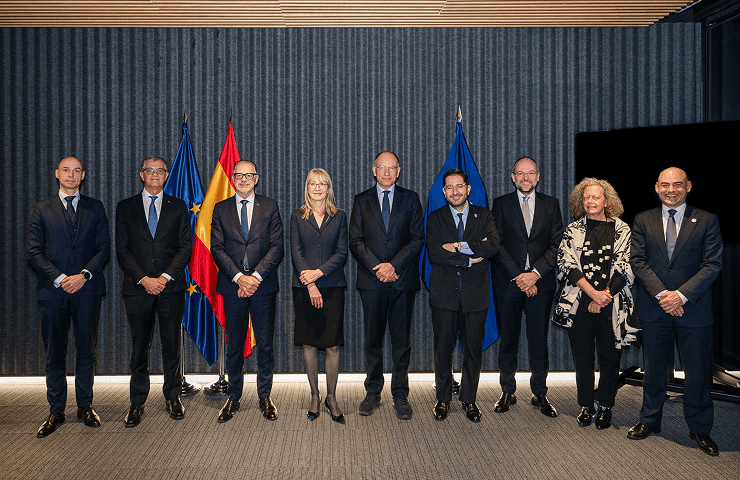
The signing ceremony, held today at IE University, was attended by Josef Aschbacher, Director General of ESA, Manuel Muñiz, Provost of IE University, and Enrico Letta, Dean of the IE School of Politics, Economics & Global Affairs.
This pioneering partnership strengthens the shared commitment of both institutions to cultivating international talent and driving progress in the global space economy. The MoU lays the foundations for jointly designed academic programmes, new pathways for professional development and collaborative projects that connect expertise across domains, while also enhancing outreach and public engagement.
The initiative is conceived as a growing platform, with new partners expected to enhance its reach, diversity and global impact.
A Partnership Aligned with a Transforming Global Space Landscape
The space sector stands at a critical juncture. While the global space economy continues to grow, fuelled by innovation, increased investment and rapidly expanding commercial activity, geopolitical competition is driving a new space race and reinforcing the imperative for major powers—including in Europe—to develop strategic capabilities and autonomy.
European State members of ESA have recently demonstrated this ambition confirming their support to ESA and its programmes—an important step that underscores the need for highly trained professionals capable of navigating a sector shaped by technological disruption, complex geopolitics and intensifying global competition.
Amid this transformation, demand for specialised talent significantly outstrips supply, not only in STEM fields but also in leadership, security, policy, business and legal roles. Addressing this gap requires a new generation of visionary, multidisciplinary leaders able to operate at the intersection of technology, innovation, management, international affairs, and defence. The partnership between ESA and IE University directly responds to this need.
"Europe’s autonomy and competitiveness in the global space sector will depend on its ability to innovate. Through our work with universities across Europe, and this new partnership with IE University, ESA reaffirms its commitment to empowering the next generation of talent and academic excellence to shape Europe’s future in space," said Josef Aschbacher, Director General of ESA.
"This agreement strengthens our mission to drive innovation and technology, opening exceptional opportunities for our students to engage with one of the most transformative sectors of the century." added Manuel Muñiz from IE University.
Building a European Foundation with Global Reach
The partnership will support the development of expertise aligned with Europe’s policy, industry and security needs, while preparing leaders to shape a competitive international space landscape.
The initiative will be powered by world-class faculty, bringing together leading academics and seasoned practitioners with extensive experience across European and global space programmes. It will also leverage the multidisciplinary strengths of four IE Schools—Global and Public Affairs, Science and Technology, Business, and Law—ensuring a holistic approach unique in the international higher education landscape.
With this agreement, ESA strengthens its role in cultivating international talent and enhancing cooperation with leading academic institutions. IE University, in turn, consolidates its position at the forefront of higher education linked to emerging strategic industries.
The two institutions will begin immediately to develop a joint roadmap, with pilot programmes and collaborative activities planned for the upcoming academic year.