- Home
- News And Events
- News
- Ie University Honors Research Excellence At The 2026 Resonance Article Awards
IE University Honors Research Excellence at the 2026 Resonance Article Awards

The awards recognize the most impactful research articles published by IE University faculty internationally, highlighting their contributions across a range of academic disciplines.
Madrid, 13 November 2026 – IE University has held a new edition of the Resonance Article Awards, recognizing research excellence among its faculty by honoring academic articles that have achieved significant international impact. The award-winning research addresses topics spanning entrepreneurship, labor law, technology, political science, the humanities, and architecture, contributing to academic debate on key challenges facing society, the business world, and public policy.
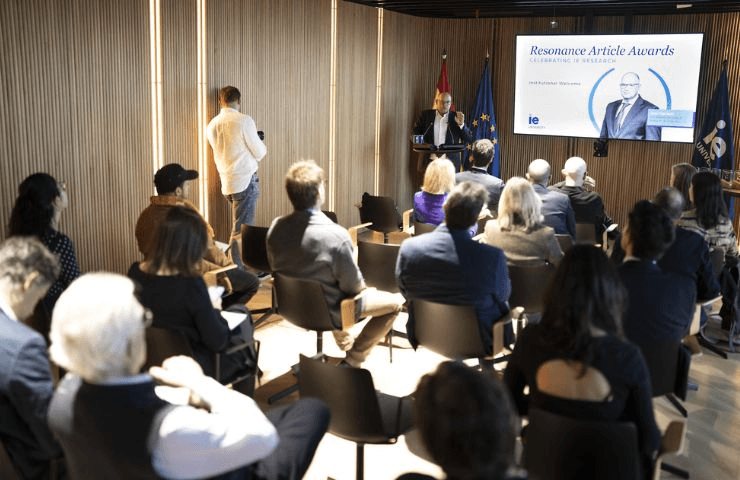
Juan Santaló, Vice Rector of Faculty & Research at IE University, emphasized: "At IE University, we believe that the ultimate purpose of research is not simply to publish, but to generate knowledge that matters and fosters positive change in society. The Resonance Awards reflect this commitment by recognizing research published several years ago that has demonstrated a lasting impact. We want to celebrate not only academic excellence, but also the ability of our faculty's research to make a meaningful difference in the world."
Marco Giarratana, Vice Rector of Scientific Knowledge & Impact at IE University, added: "Across disciplines, our award-winning research explores how people understand the world and act within it, through rational choices, bounded rationality, incentives, biases and humanistic perspectives. These diverse approaches share a common purpose: to advance knowledge that informs decisions, challenges assumptions and deepens our understanding of society and human beings. The Resonance Awards celebrate this collective contribution and its potential to inspire meaningful change."
AWARDED ARTICLES
The awarded articles explore entrepreneurial decision-making, the regulation of platform work, the use of AI in analyzing medical data, political accountability, the origins of Slavic epic poetry, and the application of robotics to traditional masonry construction.
Daniel Andrew Lerner, IE Business School
Cracks in the wall: Entrepreneurial action theory and the weakening presumption of intended rationality (Journal of Business Venturing, 2022)
This study challenges traditional assumptions about rational decision-making in entrepreneurship, examining the role of impulsive and less deliberate behaviors in entrepreneurial action.
Antonio Aloisi, IE Law School
Platform work in Europe: Lessons learned, legal developments and challenges ahead (European Labour Law Journal, 2022)
The article examines the legal and regulatory challenges of platform-based employment in Europe, analyzing labor protections, algorithmic management, and policy developments aimed at improving working conditions in the digital economy.
David Gómez-Ullate Oteiza, IE School of Science and Technology
Toward Automated Feature Extraction for Deep Learning Classification of Electrocardiogram Signals (IEEE Access, 2022)
This research develops deep learning methods for automatically extracting features from electrocardiogram signals and classifying them, exploring how artificial intelligence can support the analysis of medical data.
Michael Becher, IE School of Politics, Economics & Global Affairs
Executive Accountability Beyond Outcomes: Experimental Evidence on Public Evaluations of Powerful Prime Ministers (American Journal of Political Science, 2022)
The study investigates how citizens evaluate political leaders, examining whether public judgments depend not only on policy outcomes but also on the procedures governments use to make decisions.
Susana Torres Prieto, IE School of Humanities
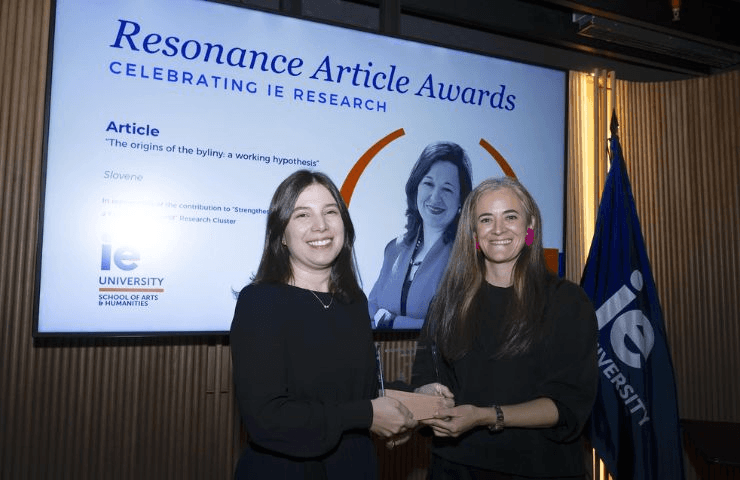
The Origins of the Byliny: a Working Hypothesis (Slověne, 2022)
The article examines the origins of the byliny, traditional Slavic epic poems, proposing that they may have originated as written compositions in a clerical environment in the northern area of Kyivan Rus', before being preserved through oral tradition.
Wesam Al Asali, IE School of Architecture and Design
Automating historical centering-minimizing masonry vaulting strategies: Applications to cooperative robotic construction (Developments in the Built Environment, 2024)
This research examines how historical masonry vault construction techniques can be adapted to robotic fabrication, using computational simulations to explore methods for reducing the need for temporary support structures during construction.