- Home
- News And Events
- News
- Ie University’s Center For The Governance Of Change Debates Europe’s Quantum Strategic Advantage At The Munich Security Conference 2026
IE University’s Center for the Governance of Change Debates Europe’s Quantum Strategic Advantage at the Munich Security Conference 2026

The roundtable marks a milestone in the second phase of the CGC’s Quantum Policy Lab.
The Center for the Governance of Change (CGC) at IE University took part last week in the Munich Security Conference 2026, where it convened a high-level roundtable titled “Taking a Quantum Leap: How to Secure Europe’s Tech Future.”
The roundtable marks a milestone in the second phase of the CGC’s Quantum Policy Lab. The focus will now turn to translating Europe’s research excellence and quantum ambitions into a functional, coordinated governance architecture and ecosystem involving the policy, industry, academia, and investment communities.
The session was opened and moderated by CGC Director Irene Blázquez Navarro. It featured participants such as:
- Ana Paula Assis, Senior Vice President of Europe, the Middle East and Africa and Growth Markets at IBM.
- André Loesekrug-Pietri, Chairman of the Joint European Disruptive Initiative; Member of the Security Innovation Board at the Munich Security Conference
- Benjamin Dittmar, Project Manager, Schaeffler
- Chi Onwurah, MP and Chair of the Science, Innovation and Technology Committee, at the House of Commons, UK Parliament
- Neil Chauhan, Director of Global Partnerships at Fortaegis Technologies
- Sorin Ducaru, Principal Advisor on AI and Emerging Disruptive Technologies, European External Action Service
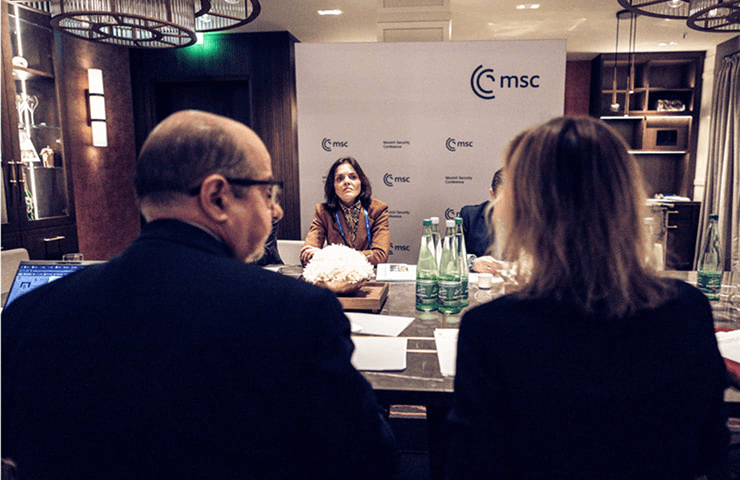
Irene Blázquez set the tone by stressing that in today's geopolitical context, building a resilient and robust quantum ecosystem has become an urgent imperative for Europe. Blázquez underscored "the strategic necessity of moving beyond fragmented efforts toward coordinated execution across civil, security, and defense communities".
A strong consensus emerged: quantum sovereignty is not simply a technological objective but a strategic condition for defense resilience and industrial competitiveness. From there, the discussion converged around a set of concrete priority actions:
- Formalized Strategic Coordination: Participants stressed the need to establish structured and sustained dialogue among EU Member States and trusted allies on strategic priorities, capital alignment, procurement frameworks, and standards-setting.
- A Use-Case Driven Investment Strategy: Rather than concentrating solely on technological milestones, participants called for prioritizing high-impact use cases in defense, cybersecurity, space, energy, and critical infrastructure to attract private investment.
- A Polymath Innovation Model: Unlocking the full potential of quantum will require interdisciplinary integration to increase the scalability and strategic impact of the technology.