
Container shipping plays a crucial role in global trade, enabling efficient movement of goods between ports worldwide. In container shipping, vessels visit several ports to load and unload containers. The arrangement of containers within the ship affects how efficiently these operations can be performed. Poor planning can lead to relocations, where containers must be temporarily moved to reach others beneath them. These extra movements increase handling time and costs. We aim to develop an effective stowage plan that minimizes relocations and optimizes the efficiency of port operations throughout the voyage (Taha, 2017).
What was your project about ?
What was your project about ?
We were tasked with optimizing the stowage planning of a container ship to minimize unnecessary relocations. This required formally defining what constitutes an unnecessary relocation, as well as specifying the decision variables, constraints, and objective function of the model.
What impact or real-world problem were you aiming to address, and how could your solution be applied in a real organization or industry?
What impact or real-world problem were you aiming to address, and how could your solution be applied in a real organization or industry?
The problem we were tasked with is highly correlated with real-world stowage planning scenarios, albeit on a significantly smaller scale. In practice, ship routes are optimized across hundreds or thousands of ports and involve vast numbers of containers, rather than the four ports considered in our model. However, the underlying structure of the solution remains largely the same.
Our formulation minimizes the number of unnecessary relocations, whereas in real-world settings these relocations incur costs that may vary across ports. Additionally, our model does not account for factors such as weight distribution across the vessel, container fragility, or refrigerated and special-care units.
In summary, while our model is strongly aligned with real-world stowage planning problems, it operates at a much smaller scale and with significantly simplified assumptions.
What technical approaches and tools did you use to build and test your model, and why did you choose them?
What technical approaches and tools did you use to build and test your model, and why did you choose them?
For solving our model, we used the HiGHS solver, which effectively computed the final solution, without the need of professional equipment. The only required inputs were ship dimensions and basic container information (origin, destination, and stacking limits), making the method easily generalisable to different vessel constraints or routes.
Please tell us about your project's:
Please tell us about your project's:
Methodology:
To solve the container stowage problem, we built an optimisation model that simulates how containers are placed on a ship as it travels through a sequence of ports. The goal of the model is to minimise unnecessary container relocations, which are extra moves required when a container that needs to be unloaded is blocked by others on top of it.
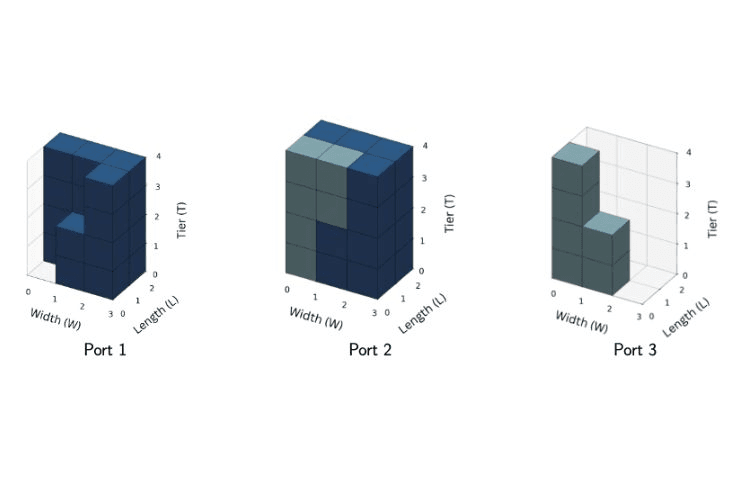
We start by representing the ship as a collection of stacks and tiers, similar to vertical columns where containers can be placed. Each container has a known origin port, destination port, and a structural limit on how many containers can safely be stacked above it. The model tracks, for every port, where each container is located—or whether it is on board at all.
At each port, the model decides:
- which containers are loaded,
- which are unloaded,
- where remaining containers are placed on the ship,
- and whether any container must be relocated to allow others to be accessed.
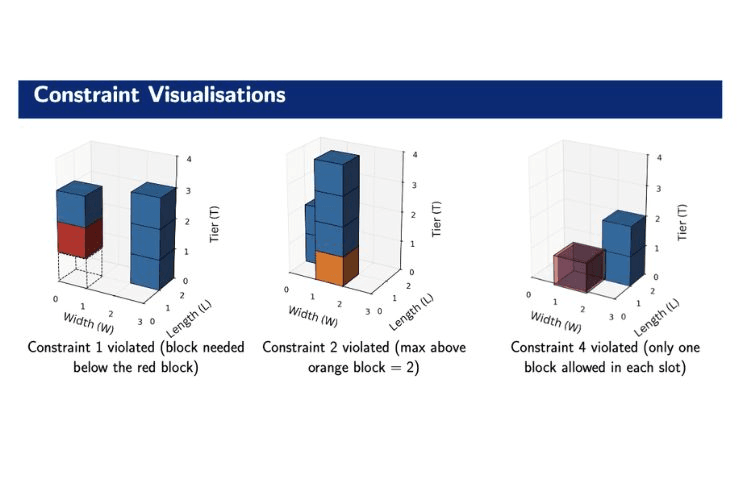
To ensure the plan is realistic, we include operational rules that reflect real shipping constraints. Containers must be stacked from the bottom up, only one container can occupy a slot at a time, and containers cannot exceed their stacking limits. We also ensure that containers only appear on the ship between their loading and unloading ports.
Relocations are detected by comparing a container’s position before and after a port operation. If a container changes position and this movement is not explained by a normal load or unload, the model counts it as a relocation. The optimisation process then searches for the placement strategy that results in the fewest total relocations across the entire journey.
By combining these rules into a single optimisation model, we are able to generate a complete stowage plan that is feasible, efficient, and directly interpretable from an operational perspective. The result is not just a mathematical solution, but a practical loading strategy that reduces handling time, operational cost, and unnecessary ship movements.
Results:
The model successfully produced an efficient and feasible loading plan for the entire journey. Importantly, it was able to do this very quickly, running in under a minute on a standard laptop, which shows that effective planning does not require specialised or high-end computing equipment.
Looking at the results from an operational point of view, the outcome is very practical. Only one port along the route requires a small, planned rearrangement of containers, while all other ports can carry out their loading and unloading smoothly without any interruptions. This means port operations become more predictable, equipment and staff can be scheduled more efficiently, and the risk of delays caused by unexpected container moves is significantly reduced.
We also designed the model to be flexible. Instead of hard-coding values, all ship characteristics, container information, and port operations are provided as input data. This means that if conditions change—such as ship size, route, or container constraints—the model can be easily adapted without rebuilding it from scratch.
Conclusions:
This project shows that optimisation techniques can be effectively used to improve real-world container shipping operations. By carefully planning how containers are placed on a vessel, it is possible to significantly reduce unnecessary movements during port calls.
Fewer relocations translate directly into lower operational costs, shorter handling times, and more reliable schedules. There are also sustainability benefits, since reducing container movements lowers energy use and port congestion.
Overall, the approach demonstrates how mathematical optimisation can support better decision-making in logistics. With further development, the same method could be applied to larger ships, longer routes, or more complex operational settings, helping shipping companies improve efficiency and reliability on a broader scale.
Was there a challenge during the process, and how did you manage to overcome it?
Was there a challenge during the process, and how did you manage to overcome it?
It was initially challenging to tackle such a demanding project, yet very rewarding and engaging. To start with, we needed to translate real-world factors into mathematical variables. This took hours formulating and reformulating the problem. With the advice of our Optimization professor, Manuel Navarro-García , and with a lot of teamwork and perseverance, we overcame the challenge and developed a functional model.
How did teamwork contribute to the success or progress of your project?
How did teamwork contribute to the success or progress of your project?
Teamwork was essential to our success because from the very beginning we communicated our ideas clearly and ensured everyone understood the direction of the project. We spent a significant amount of time carefully analyzing the core of the problem and developing a precise formulation, which created a strong foundation for the later stages of our work. By dividing tasks fairly, according to each member’s strengths and weaknesses, we managed to work efficiently and achieve strong results.
Which key skills (soft and hard) have you acquired or strengthened during this experience?
Which key skills (soft and hard) have you acquired or strengthened during this experience?
Throughout this experience, we strengthened several soft skills, especially those related to communicating ideas effectively and giving engaging presentations. In terms of hard skills, we enhanced our coding abilities and problem-solving techniques for optimization. We learned how to reformulate our task in order to make sure it is simpler and more compact, which was essential for developing an efficient solution and reducing unnecessary complexity. This helped us focus on the key variables and constraints, making the implementation and analysis much more manageable and interpretable.
Do you have plans for further development or improvement of your project in the future?
Do you have plans for further development or improvement of your project in the future?
It definitely intrigued us how the stowage problem can be solved at larger scales, in industries such as navigation. We have already delved into resources that study similar optimization models in order to achieve more applicable results, and we are curious to further read, study and develop this project and others alike. There is plenty of room for improvement and we are excited about how with every step we are making throughout the degree, more techniques, methods and problems are offering us the chance to think critically, overcome limitations and challenge assumptions.
Did participating in this project help you better understand how your bachelor translates into real-world or applied contexts? How?
Did participating in this project help you better understand how your bachelor translates into real-world or applied contexts? How?
Working on this project helped us see how theory and abstract problems from the classroom can be applied directly to the real world. What we usually see in class as sets, constraints, and objective functions became concrete: stacks were real ship slots and constraints reflected real, physical limits. Additionally, the project forced us to think like problem solvers rather than strictly theoretically. Small modelling choices had clear practical implications, such as how relocations affect optimality or how structural constraints affect feasibility. Overall, the project helped us see our bachelor not just as a collection of mathematical tools, but as a practical toolkit for solving complex, real logistics and operations problems, the exact kind of bridge between theory and practice that applied mathematics is meant to create.
Pictures
Pictures
Link to project
Link to project